
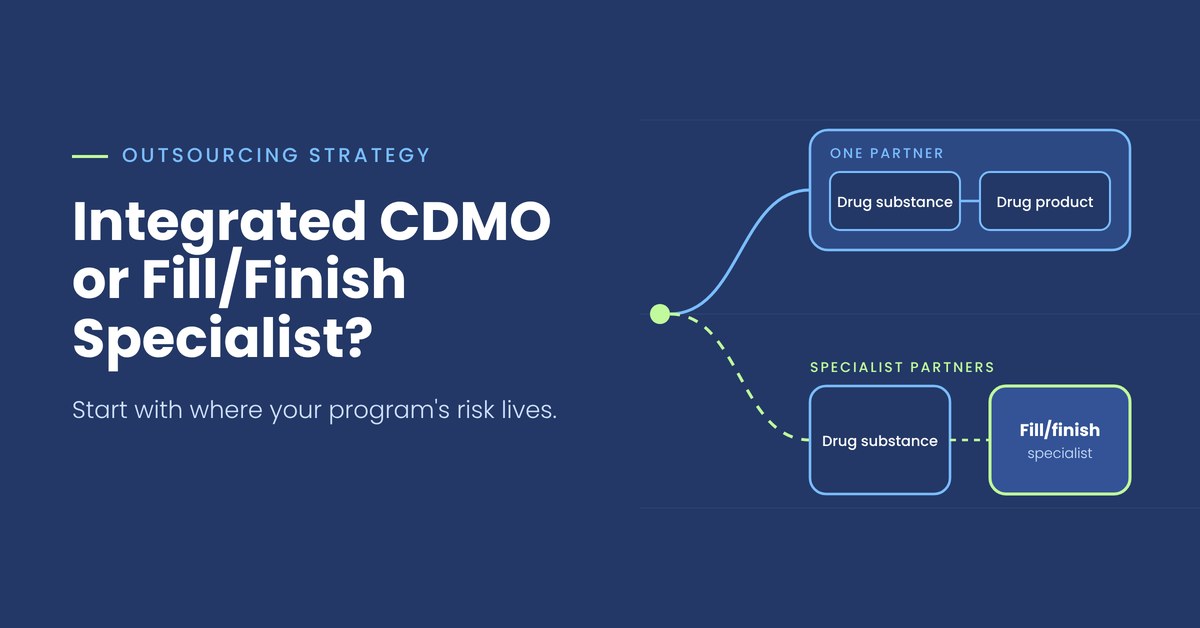
Sponsors outsourcing a sterile injectable face a structural choice. They can keep drug substance and drug product with one integrated partner, or place sterile fill-finish with a specialist and manage the drug substance relationship separately.
Both models support successful programs, and both carry trade-offs that are easy to underweight early and costly to revisit later. Framed as a contest between models, the conversation tends to stall on generalities. A more useful question is narrower: where does this program’s technical and operational risk concentrate? The answer differs from one product to the next, and it shows which step most needs a partner’s focus. From there, the choice comes down to whether the program is better served by focused depth at each step or by one organization accountable for both.
What Each Model Actually Offers
An integrated CDMO manufactures drug substance and fills drug product within one organization. The potential advantages are structural: fewer external handoffs, one commercial relationship, and potentially one quality agreement covering both steps. If a problem surfaces between drug substance release and fill, one organization is accountable for resolving it.
A fill-finish specialist concentrates on aseptic manufacturing of the drug product. Its capital, process development and hiring go into sterile filling: aseptic technology, container formats, contamination control and the analytical work behind release. Its whole team is focused on the step where a formulated product becomes a sterile, sealed dose. Splitting the work also lets the sponsor choose its drug substance partner on the same basis, matched to the product and its process. Each partner then focuses on its own step.
Each model also asks something of the sponsor. With an integrated partner, fill-finish is one of several capabilities sharing the organization’s investment and attention, and the sponsor gives up some freedom to choose a best-fit partner for each step. With a specialist, the sponsor manages two relationships and owns the coordination between them, including timelines, material readiness, documentation and product knowledge. Neither trade-off rules a model out, but each has to be weighed against the program, not assumed away.
Where Does Your Program’s Risk Live?
Either model can meet a wide range of technical requirements. What these five questions reveal is where the program’s risk concentrates: upstream, in the drug product, or in the sponsor’s own capacity to coordinate. No single answer decides the model, but the pattern across them points toward the one that fits:
- How novel or complex is the drug substance process? A new expression system, a process still being characterized, or a product that is fragile between manufacture and formulation concentrates risk upstream. That risk can be met two ways: integration, which removes an external handoff, or a drug substance specialist, which brings concentrated depth to the process itself.
- How demanding is the drug product? Temperature limits, potency, viscosity, and shear or aggregation sensitivity shape how a product behaves through filtration and filling. The more of these attributes a product carries, the more of the program’s risk sits in fill/finish, and the more weight depth at that step deserves when comparing partners.
- Will the presentation change? A planned move from vials to prefilled syringes or cartridges adds drug product work across the program’s life, from components to fill equipment to container closure. Each planned change shifts more risk toward the fill-finish step.
- What is the commercial horizon? A long commercial horizon makes fill-finish capacity, team continuity and release capability a lasting dependency. The longer that dependency runs, the more the partner’s sustained commitment to fill-finish matters relative to the advantages of a single relationship.
- Can the internal team coordinate two partners? Split arrangements depend on a sponsor who actively manages both relationships.
The drug product questions carry particular weight because of what sterile fill/finish is. It is the last manufacturing step before a product reaches a patient, and it is where sterility assurance is built. That assurance comes from how the product is made: facility design, aseptic technique, contamination control and validated processes. Sterility testing at release then confirms what the process was designed to deliver. That makes the depth of a fill-finish operation a patient safety question as well as an operational one.
When an Integrated CDMO Makes Sense
Some programs are better served by integration and recognizing them is part of choosing well.
Drug substance and drug product are tightly coupled. Some specialized drug substance processes exist where little separates making the substance from preparing the final dose. Keeping both steps with one team can remove a handoff that would otherwise carry significant risk.
One accountable party is the priority. For some sponsors, a single quality system and a single point of accountability across both steps outweigh specialist depth at either one. That is a legitimate governance choice.
The internal team is lean. Coordinating two partners takes sustained attention from CMC, quality and program management. A sponsor without that bandwidth can lower its own execution risk by consolidating relationships.
In each case, integration fits because the most important risk sits in the connection between steps, or in the sponsor’s capacity to manage that connection.
When a Fill-Finish Specialist Makes Sense
From a fill-finish perspective, the specialist model’s advantages come down to two things: focus and selection.
Focus. A specialist’s capital, process development and hiring all go to fill-finish. Aseptic technology, container formats and release capability sit at the center of its investment roadmap rather than sharing it with other steps.
Selection. A split arrangement lets the sponsor choose its fill-finish partner on fill-finish criteria alone, independent of the drug substance decision. Those criteria include its aseptic technology, such as isolators (designed to separate operators from the Grade A environment), the presentations it has run and how its QC lab is integrated with manufacturing.
Those advantages carry the most weight in three situations:
- The drug product is demanding. Shear-sensitive, viscous, potent or temperature-limited products put more of the program’s risk in the filling step itself.
- Presentation changes are planned. A move from vials to prefilled syringes or cartridges keeps adding fill-finish work over the program’s life.
- The commercial horizon is long. The longer a program depends on fill-finish capacity and release capability, the more a partner’s sustained commitment to that step matters, including a fill/finish team that stays with the product from clinical through commercial.
Questions That Reveal Depth, Whichever Model You Choose
Model labels describe structure. These questions test substance:
- Where does fill/finish sit in the partner’s investment roadmap? Ask what aseptic equipment, lines and lab capacity are planned, and how that plan supports commercial supply.
- For an integrated provider: where, and by whom, are drug substance and drug product made? Ask whether both steps happen at the same site under the same team. If material moves between facilities, that move still involves shipping, documentation and a receiving team learning the product.
- Which presentations and batch-size ranges has the partner actually run? Ask for demonstrated history in the formats and scales the program needs, not stated capability.
- How experienced is the aseptic operations team? Ask how operators are trained and qualified, how interventions are managed and how media fills are designed.
- How is the QC lab integrated with manufacturing? Ask which release and stability tests are performed on site and which are sent out.
For broader evaluation criteria, including capacity, project management and quality culture, see “What Procurement Teams Should Actually Be Evaluating in a Fill-Finish RFP”.
If You Choose a Specialist, Own the Coordination
The specialist model’s trade-off doesn’t end when contracts are signed. In a split arrangement, there is typically no quality agreement between the drug substance manufacturer and the fill/finish CDMO. Governance runs through the sponsor, who holds a separate agreement with each.
That arrangement works when the sponsor’s ownership is active: quality agreements that define incoming requirements and escalation paths, one timeline all three parties work from, and communication that moves schedule changes and product knowledge to the people who need them. “The Drug Substance-to-Fill-Finish Handoff: What Sponsors Need to Know” covers how to set that up.
Choose for the Program in Front of You
There is no universally right outsourcing model for sterile injectables, only the right fit for where a program’s risk lives. Integration earns its place when the hardest problems sit in the connection between steps, or when one accountable organization matters most. A specialist earns its place when they sit in the drug product, where focused depth and the freedom to choose the fill-finish partner pay off. Some programs fall in between and call for judgment rather than a rule.
Whichever model fits, every party involved shares the same goal: a safe, reliable supply for the patients the program is meant to serve.
When a program’s risk lives in sterile fill-finish, depth in that step is what to look for. Afton Scientific specializes exclusively in sterile injectable fill-finish, supporting programs from Phase 1 through commercial manufacturing with an Annex 1–compliant isolator line for vials, prefilled syringes and cartridges, an integrated in-house analytical lab, and a new facility under construction built for four high-speed filling lines. To learn more, visit aftonscientific.com.