What the Backend Actually Looks Like
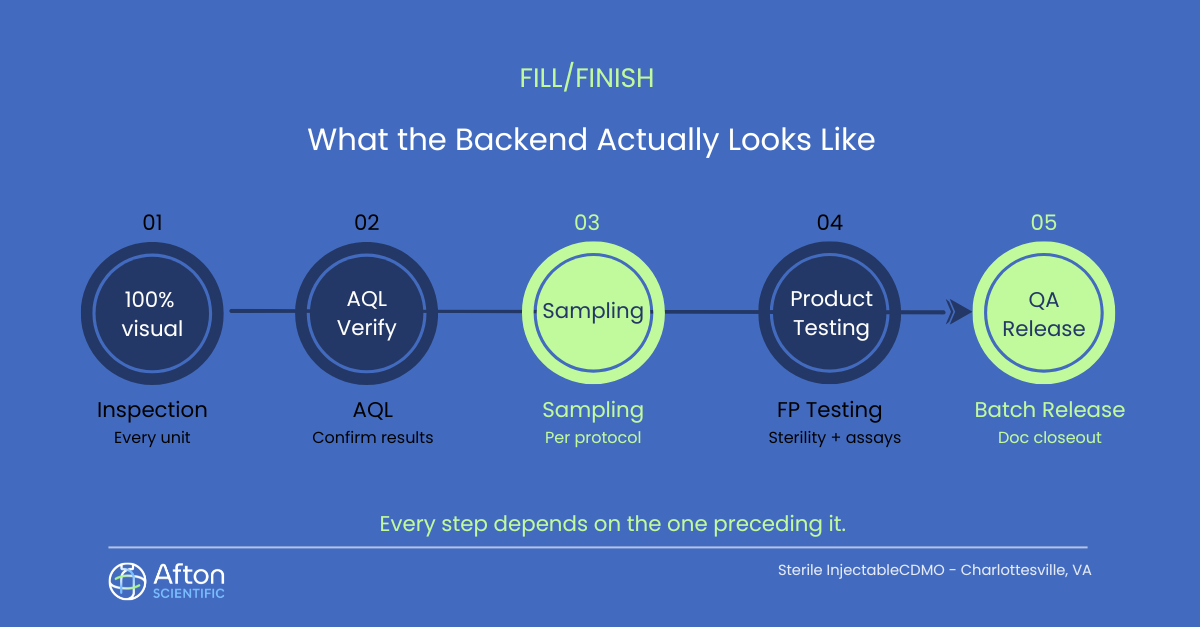
Once a sterile injectable fill is complete, the product is not ready to ship. It is at the beginning of a distinct phase with its own sequence, dependencies, and timeline. From a fill/finish perspective, that sequence runs in a fixed order:
- 100% visual inspection of every unit
- AQL verification of the inspection results
- Sampling
- Finished product testing
- QA review and closeout of all documentation generated across preparation, manufacturing, inspection, sampling, and testing
Every step depends on the one preceding it. All are necessary.
There is often less time spent planning the backend of a fill/finish program than manufacturing, since the most visible risks arise during manufacturing. This can lead to an incomplete timeline: a drug product can be successfully filled, inspected, and sampled and still have a significant wait before it is ready to ship. Planning the backend alongside manufacturing — rather than after it — is one of the most straightforward ways to avoid timeline surprises at the end of a program. The steps are predictable, and the sequence is consistent. The main variable is how complex the finished product testing package is for a given program.
Finished Product Testing: What Is in It and What Drives the Timeline
Finished product testing varies widely depending on the product, its regulatory status, and its stage of development. There is no standard protocol that applies across all programs. At minimum, all sterile injectable products require sterility testing, bioburden, and endotoxin. Beyond those requirements, testing generally includes some combination of identity, pH, osmolality, appearance, and assays. Additional tests may be required based on a product’s specific regulatory requirements.
The variability in testing requirements is the primary driver of backend complexity. A program with a straightforward testing package has a meaningfully shorter backend timeline than one with more extensive requirements. Understanding the testing package before manufacturing begins is what makes it possible to build a timeline that accounts for the full backend.
Two structural features of the testing phase require specific attention. First, sterility testing has a fixed incubation period that sets a non-negotiable floor on how quickly a batch can move through release, regardless of how smoothly everything else goes. That window cannot be compressed by expediting other steps or adding resources. Second, documentation review and QA batch release run concurrently with and following finished product testing — not as a separate phase that begins once testing is complete. The QA review and closeout of all documentation generated across the full program is the CDMO’s responsibility and is what constitutes batch release. Some sponsors choose to review documentation prior to release as well. That is an internal decision, but it is additive to the timeline and worth communicating to the CDMO early rather than introducing it late in the process.
Where testing takes place has a meaningful impact on backend timing. The smoothest setup is an integrated, in-house analytical lab — one where the CDMO has full visibility and control over timing, without concerns about shipping across organizations or capacity constraints at critical release moments. When testing is outsourced, each of those variables — shipping logistics, lab scheduling, and information turnaround — becomes a dependency the sponsor does not fully control.
Label and Pack: The Most Consistently Underestimated Element
Labeling and packaging carries its own validation burden, its own regulatory review requirements, and its own patient safety stakes. A peer-reviewed analysis of FDA recall data from 2012 to 2023, published in the Journal of Pharmaceutical and Biomedical Analysis, found that labeling and packaging issues were the third most common cause of drug recalls, accounting for nearly one in five recalls over that period.
At commercial scale, the scope of label and pack is broader than sponsors who have not been through it typically anticipate. It encompasses:
- Saleable unit configuration — whether product ships one vial per carton, six, twelve, or another count
- Outer shipping carton and pallet configuration
- Label content, graphics, lot number, and expiration dating
- Serialization and data transfer to the serialization partner
Each element needs to be defined, validated, and reviewed. The label and pack process requires validation in the same way the fill process does. Labels and packaging must be reviewed and approved by the relevant regulatory body. Shortcuts taken here do not disappear — they surface during regulatory review, often at the worst possible moment.
For commercial programs, label and pack validation can occur following registration batch production and be included in the filing — but it still has to happen, and it needs to be in the program plan from the start.
A practical signal of a CDMO’s thoroughness is whether they ask about label and pack early — during proposal conversations, before a contract is signed. A capable CDMO asks specific questions at that stage:
- How is the product being packaged for sale?
- What are the shipping configuration and pallet requirements?
- What label content and graphics does the sponsor require, and does the CDMO need label printing capabilities for lot number and expiration dating?
- Who is the serialization partner, and how will data transfer work?
A CDMO who raises these questions early is surfacing requirements before they become surprises — which is exactly when they should be addressed.
For sponsors focused on sterile injectables fill/finish, having a CDMO who surfaces backend requirements early — before a contract is signed — is one of the most practical ways to build a timeline that holds. Afton Scientific specializes exclusively in sterile injectables fill/finish, supporting programs from Phase 1 through ongoing commercial manufacturing. To learn more, visit aftonscientific.com or email bizdev@aftonscientific.com.