
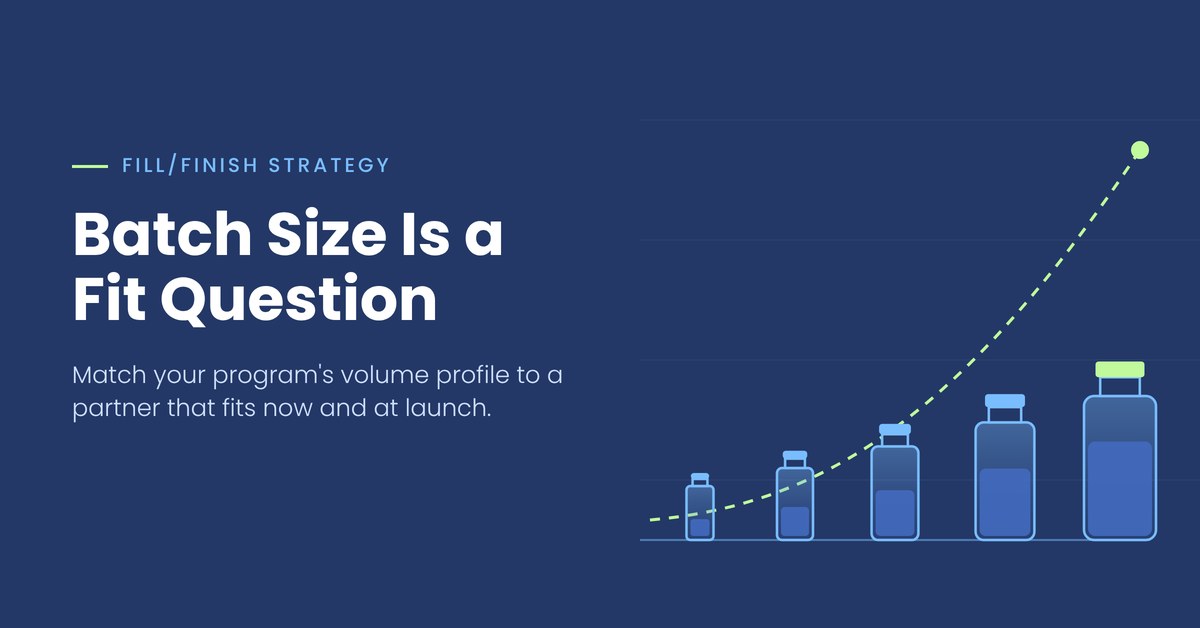
Capacity is one of the first things sponsors look at when evaluating a fill-finish partner, and it’s natural to reduce it to size: how large the batches are, how big the operation is. Size is easy to compare. It just doesn’t say much about fit.
Size describes a CDMO at a single moment. A sponsor, meanwhile, is choosing a partner for a trajectory: a program that may begin with a handful of clinical batches and, if it succeeds, become a commercial product with its own supply rhythm, presentation and patient population. A partner sized right for a program’s first year may not be sized right for its fifth.
From a fill/finish perspective, the more useful question isn’t how big a CDMO is. It’s whether the CDMO’s capacity profile matches the program’s volume profile, both now and where the program is headed. That reframes changes what sponsors look for, what they ask and when they revisit the decision.
Your Volume Profile Is a Moving Target
A program’s volume needs change at nearly every stage of development. Phase 1 supply is sized to a small study population, often while dose and concentration are still being refined. Later-phase studies enroll more patients across more sites. Commercial supply then adds a recurring cadence that clinical supply typically doesn’t have.
Indication shapes the destination. A rare disease therapy may reach full commercial demand at modest annual volumes, while a product for a broad indication may need many times that output. Two programs at the same clinical phase can be headed toward very different commercial pictures.
Presentation can shift, too. A product that enters the clinic in vials may move to a prefilled syringe or cartridge for commercial launch. Each change affects fill volume, line compatibility and batch economics.
Commercial forecasts also carry real uncertainty, particularly for novel therapies with no market precedent. Uptake can run ahead of projections or behind them, and supply planning has to absorb either outcome.
That’s why batch size alone is an incomplete description of what a program needs. A volume profile combines batch size, batch frequency, presentation and trajectory. Behind every forecast in that profile is a patient population depending on supply, which is a strong reason to define the profile deliberately rather than infer it from the current phase.
What Defines Your Program’s Volume Profile
Before evaluating partners, it helps to describe the program’s needs in terms a CDMO can match against. Five inputs carry most of the weight.
Patient population and dosing regimen. How many patients, how often they’re dosed and for how long together determine the units needed each year. A chronic therapy dosed weekly creates a very different demand curve than a single-administration product.
Fill volume and presentation. Container type, fill volume and any presentation changes on the roadmap determine which lines and platforms are realistic candidates.
Batches per year and campaign pattern. Two programs with the same annual volume can look very different on a schedule. One may run a few large campaigns a year. Another may need smaller, more frequent batches to manage expiry, inventory or regional supply.
API value and availability. When API is scarce or high-value, matching batch size to actual need carries more weight. Committing material to a batch larger than the program requires has a real cost.
Confidence in the forecast. A well-characterized market supports firmer capacity commitments. An uncertain one calls for a partner with range in both directions.
Writing these down, even as estimates with ranges, gives sponsors a shared language for partner conversations and a baseline to revisit as the program matures. It also shows where the forecast is weakest, which is where flexibility deserves the most weight
Mismatch Cuts Both Ways
Fit problems aren’t limited to programs that outgrow their partner. They show up in both directions, and neither is a quality failure. Both are questions of structural fit.
When a program sits well below the range a line is built for, the friction is mostly economic. Setup, changeovers and minimum batch requirements are sized to the line’s design. A much smaller program may carry costs it doesn’t benefit from, or commit more API to a batch than it needs.
When a program outgrows its partner, the constraint tends to arrive when it’s hardest to absorb. A CDMO that was the right fit for clinical supply may not have the line configuration or sustained capacity for commercial demand. If that becomes clear late, the remedy may be a technology transfer, undertaken while the sponsor is also preparing a filing, building launch inventory or responding to uptake. At that stage, a capacity gap doesn’t stay a scheduling problem. It reaches patients, as a delayed launch or interrupted supply.
Neither outcome means anyone made a careless decision. Programs change, forecasts move and CDMOs grow on their own timelines, so a partnership that fits well at selection can drift as either side evolves. What sponsors control is timing: fit is easier to assess, and to act on, before the program’s needs and the partner’s profile have diverged far enough to force a decision under pressure.
Questions That Reveal Fit
- What batch size range has this line actually run, by presentation? Stated capability describes what equipment is designed to do. Demonstrated history describes what the team has done with it. Ask about both ends of the range, for each container format the program may use.
- How would you support a program whose batch size grows several-fold between clinical and commercial supply? The answer shows whether growth can happen within the partnership, on the same line, a larger line or a new facility, or whether it would require a move. If growth means a different line, ask what carries over: equipment platform, documentation and the people who know the product.
- Which presentations run on the same platform, and can a program move between them without starting over? If a vial-to-syringe transition is on the roadmap, understand how much existing process knowledge and qualification work would transfer.
- How do you schedule programs of different sizes and cadences on the same line? A partner with a clear, specific answer has thought through how every program on its calendar gets served, the largest. That’s more useful than a general assurance.
- What does your capacity roadmap look like, and how does it line up with our forecast? Expansion plans are most relevant when their timing matches the program’s needs, so ask about sequencing as well as scale.
These questions focus on volume fit. For questions that test whether stated capacity is real, including laboratory and engineering bandwidth and how a partner flexes when demand exceeds its schedule, see What Procurement Teams Should Actually Be Evaluating in a Fill/Finish CDMO RFP. For a fuller evaluation of commercial-scale capability, see Scaling from Clinical to Commercial with the Same CDMO: Pros, Pitfalls, and How to Plan.
Plan for the Trajectory, Not the Snapshot
Fit is assessed at partner selection, but it’s worth revisiting at each phase transition. By then the program’s volume profile is clearer and the partner’s own capacity plans have moved forward. Each review is a chance to confirm alignment, or to start planning for change while there’s still time to do it well.
The strongest partnerships are the ones where the CDMO’s growth path and the program’s growth path line up, and where the capacity a program will need at launch is part of the partner’s plan before the program needs it. Patients don’t experience batch size. They experience whether supply shows up, and planning for fit across the full trajectory is how sponsors and their partners protect that.
Afton Scientific is a U.S.-based sterile injectable fill/finish CDMO supporting programs from Phase 1 through commercial manufacturing. Its isolator-based filling line fills vials, prefilled syringes and cartridges in batches of up to 200,000 units, and a new facility under construction is designed to accommodate four high-speed filling lines, giving programs a path to grow without changing partners. To learn more, visit aftonscientific.com.